
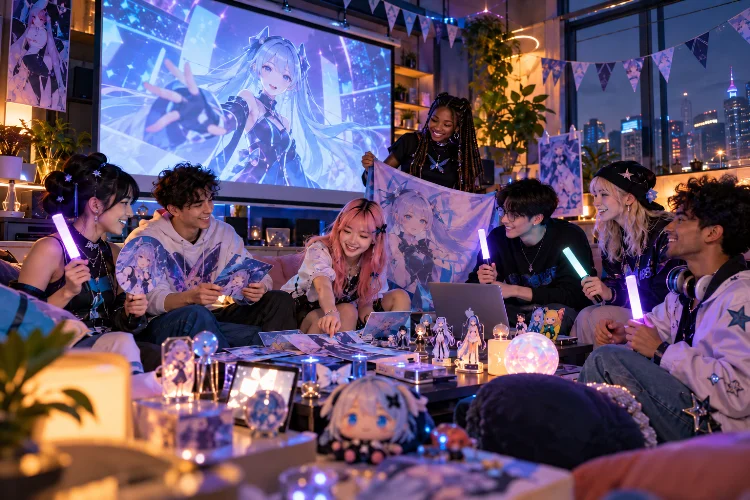
Have you ever noticed how virtual idol fans seem to speak their own language?
They share inside jokes, recognize special symbols, celebrate fictional birthdays, and sometimes organize entire online events for performers who exist primarily through digital avatars.
To outsiders, these activities might seem like ordinary internet entertainment. But for dedicated fans, they’re part of something much more meaningful.
They’re expressions of community identity.
Understanding how community identity shapes global virtual idol fan behavior helps explain why people across different countries, languages, and cultural backgrounds develop strong connections around the same digital entertainers.
Whether it’s a Japanese VTuber, a Korean virtual idol group, or an independent AI-powered performer, the experience often goes beyond simply enjoying music or livestreams.
Fans build friendships, establish shared traditions, collaborate on creative projects, and develop a sense of belonging that influences their online behavior.
However, these connections also introduce interesting challenges involving cultural differences, social expectations, emotional attachment, and community management.
Let’s explore how collective identity influences global virtual idol fandoms and why understanding these dynamics matters for creators, entertainment brands, and digital communities.
1. Understanding Community Identity in Virtual Idol Fandoms
Before exploring fan behavior, it’s important to understand what community identity actually means.
In simple terms, community identity develops when people begin seeing themselves as members of a particular group.
That membership becomes part of how they describe themselves, interact with others, and make decisions.
How Social Identity Influences Fan Behavior
Social identity theory suggests that people develop aspects of their self-image through the social groups they belong to.
These groups might include professional communities, sports supporters, gaming communities, or entertainment fandoms.
Virtual idol communities operate through similar psychological processes.
A viewer who initially enjoys a digital performer’s music might gradually become involved in livestream discussions, fan art projects, and online conversations.
Eventually, being part of the fandom becomes personally meaningful.
Research by Groene and Hettinger, published in Psychology of Popular Media Culture, examined how fan identification affected participation among Harry Potter and Twilight fans.
Their study involved 261 participants and found that highly identified fans whose group identity was affirmed demonstrated stronger engagement in a fandom-related task.
Although the research didn’t focus specifically on virtual idols, it illustrates how feeling recognized as a group member can influence participation.
For digital entertainment creators, the implication is interesting: fans may engage more deeply when they feel their membership matters.
From Individual Interest to Collective Belonging
Imagine discovering a fictional virtual singer called Aster Luna.
At first, you simply enjoy her electronic pop music and futuristic character design.
Then you join a livestream and notice viewers greeting each other using a special community phrase.
Someone explains that her followers call themselves the Moonkeepers.
After attending several performances, you begin recognizing familiar usernames and participating in shared traditions.
Your relationship with the entertainment experience has changed.
You’re no longer just watching Aster. You’re becoming part of a social group connected through her character.
That sense of belongng can encourage repeat participation, stronger friendships, and greater interest in future activities.
2. How Shared Symbols and Fan Traditions Shape Online Behavior
Strong fandoms often develop recognizable cultural elements.
These might include official fandom names, custom emojis, recurring jokes, fan-created terminology, or traditions surrounding important events.
Although these details seem small individually, together they help establish a shared community culture.
Creating a Recognizable Fandom Language
Language is one of the simplest ways people communicate group membership.
Virtual idol communities frequently develop expressions that only regular viewers immediately understand.
For example, Aster Luna’s followers might use a moon emoji whenever she announces a new song.
They could also have a playful greeting inspired by her fictional space-travel storyline.
Over time, these expressions become recognizable signals within the community.
Fans can identify other members through comments, usernames, hashtags, and social media conversations.
This creates familiarity even when participants have never met in person.
However, fandom terminology should remain easy for newcomers to learn.
Too many unexplained references can make new viewers feel excluded rather than welcomed.
Why Collective Rituals Matter
Recurring activities help transform casual interest into shared experiences.
Birthday celebrations, debut anniversaries, concert watch parties, and album-release events provide opportunities for fans to interact.
Imagine the Moonkeepers celebrating Aster’s fictional birthday through a worldwide online event.
Fans from different countries contribute illustrations, musical covers, and short messages.
Even though participants live thousands of miles apart, they’re taking part in the same celebration.
These collective experiences can strengthen the perception that fandom membership involves meaningful social participation.
They also create memories that members can reference during future interactions.
For creators, maintaining consistant community traditions can help establish familiarity without requiring constant promotional campaigns.
3. How Global Virtual Idol Communities Connect Across Cultures
One of the most fascinating aspects of virtual entertainment is its ability to attract international audiences.
A performer broadcasting from Japan or South Korea might have dedicated supporters in Indonesia, Brazil, the United States, and numerous other countries.
However, global accessibility doesn’t automatically eliminate cultural differences.
Fan Translation as a Cultural Bridge
Language barriers can prevent international viewers from fully understanding livestream conversations, song lyrics, or character personalities.
Dedicated fans often help overcome these barriers through translated clips, subtitles, and explanatory content.
A 2026 study by Seryun Lee, published in Convergence, examined fan translation in K-pop and its contribution to cross-cultural communication.
The research describes translation as a creative activity that helps cultural content circulate across linguistic and geographical boundaries.
This concept also applies to virtual idol fandoms.
Imagine Aster Luna primarily livestreaming in Japanese.
An Indonesian fan might translate a funny conversation into Bahasa Indonesia, while another supporter creates English subtitles.
Those translations introduce the character to audiences who might otherwise struggle to connect with her personality.
Importantly, fan translation involves interpretation rather than simply replacing words.
Humor, cultural references, and emotional expressions don’t always transfer directly between languages.
Accurate translations should preserve meaning while helping international viewers understand the original context.
Different Cultures Bring Different Expectations
Global audiences don’t necessarily share identical entertainment habits.
Some fans prefer highly organized promotional campaigns, while others enjoy informal interactions and independent creative activities.
Communication styles also vary.
A joke considered harmless in one cultural context might seem confusing or inappropriate in another.
Likewise, expectations surrounding privacy, donations, fan interactions, and official announcements can differ.
Virtual idol communities need to acknowledge those differences instead of assuming everyone approaches fandom identically.
Multilingual guidelines, culturally aware moderation, and respectful discussions can make international spaces more welcoming.
The goal isn’t eliminating cultural differences.
It’s creating opportunities for people to understand one another while enjoying a shared interest.
Time Zones and Global Participation
Time zones introduce another challenge.
A livestream scheduled conveniently for Japanese audiences might begin in the middle of the night for European or American viewers.
This can create unequal opportunities for participation.
Creators can respond by publishing recordings, providing translated summaries, and occasionally rotating special-event schedules.
Community-led watch parties can also help fans enjoy content at locally convenient times.
These adjustments communicate that international participation matters.
Over time, they can strengthen connections between regional communities without requiring everyone to remain online simultaneously.
4. How Fan Creativity Strengthens Collective Identity
Virtual idol fandoms are particularly interesting because fans often participate in producing the culture surrounding their favorite performers.
They’re not limited to watching official content.
Many become active contributors who help shape how characters are celebrated, interpreted, and introduced to new audiences.
Fan Art, Remixes, and Collaborative Projects
Consider the creative ecosystem surrounding Hatsune Miku.
According to Crypton Future Media’s official Piapro website, Miku and other Piapro Characters have inspired extensive collaborative creation involving music, illustrations, and other artistic works.
The platform’s name reflects the concept of peer production, where people contribute different skills to create something together.
This offers an important example of collective creativity in virtual entertainment.
Fans can develop personal interpretations while remaining connected through a recognizable character.
For a smaller virtual idol community, similar participation might include fan art contests, music remix projects, animated clips, or fictional storytelling challenges.
These activities allow individuals to express their creativity while contributing to something larger.
A musician, illustrator, and video editor might collaborate on a fan-made performance despite living in different countries.
The resulting project becomes both creative entertainment and a shared community achievement.
Why Creative Participation Influences Loyalty
Creating something requires a different level of engagement from simply watching a video.
A fan who spends several evenings illustrating a character may develop personal memories connected to that experience.
They might also build friendships with other artists or receive encouragement from community members.
These interactions can strengthen their connection to the wider fandom.
However, creators should avoid assuming that more participation always means healthier engagement.
Fan projects should remain voluntary, enjoyable, and respectful of individual limitations.
Clear copyright guidelines also matter.
Hololive Production’s official derivative-work guidelines provide an example of how virtual entertainment companies can establish conditions for fan-made content, including clips, music, and other creative projects.
Such policies help fans understand which activities are permitted and how they should credit original material.
Thoughtful rules make creative collabaration easier while respecting intellectual property.
5. How Community Identity Influences Spending and Support Behavior
Virtual idol communities don’t exist entirely outside commercial entertainment.
Fans regularly encounter merchandise, concert tickets, digital memberships, music releases, and opportunities to financially support their favorite performers.
Interestingly, purchasing decisions may reflect group relationships as much as individual entertainment preferences.
Why Group Identification Can Influence Financial Support
A study published in September 2026 by Jiang, Yang, and Luo examined monetary support within VTuber livestreaming communities.
The researchers surveyed 316 VTuber viewers in mainland China.
Their analysis found that perceived authenticity and interactivity were positively associated with parasocial relationships and social presence.
These factors were also connected to group identification.
Most notably, community identification directly predicted monetary support in their statistical model, while parasocial relationships and social presence did not directly predict that support.
This distinction matters.
It suggests that feeling connected to a fandom can be an important factor in financial participation.
However, the study is correlational and focused on a particular audience, so its findings shouldn’t be treated as universal proof of how every international fandom behaves.
Merchandise as a Symbol of Membership
Fans sometimes purchase merchandise because it represents their participation in a community.
A concert wristband, character keychain, or limited-edition album may carry emotional meaning beyond its practical function.
Imagine Moonkeepers purchasing matching accessories for a virtual concert.
The items allow fans to recognize fellow supporters during watch parties or physical gatherings.
In this situation, merchandise becomes a shared cultural symbol.
However, not everyone can afford official products.
A welcoming fandom should never treat purchasing power as the primary measure of loyalty.
Someone who enjoys free livestreams and participates respectfully should feel just as welcome as someone who owns an extensive merchandise collection.
The Risks of Competitive Fan Spending
Group identity can sometimes create unhealthy expectations.
Members may feel pressured to donate during livestreams, purchase every product, or participate in organized spending campaigns.
In extreme cases, financial contributions become informal status symbols.
This can create tension between fans with different economic circumstances.
Creators should encourage voluntary support and communicate clearly about optional purchases.
Healthy digital communities make room for different participation styles without turning financial spending into a competition.
6. Understanding Emotional Attachment, Fan Loyalty, and Group Boundaries
Virtual idol fandoms often involve emotionally meaningful relationships.
Fans may feel connected to a character’s personality, musical journey, fictional backstory, or interactions during livestreams.
These connections can increase enjoyment, but they also affect how members perceive and protect their community.
Parasocial Relationships and Shared Emotional Experiences
A parasocial relationship describes a one-sided emotional connection with a media personality.
Virtual performers can inspire these relationships even when audiences understand that the visible character is digitally represented.
A 2026 study by Park, Chung, and Seo examined the relationship between PLAVE, a South Korean virtual idol group, and its fandom, PLLI.
Through ethnographic observation and interviews, the researchers explored how fans navigate the relationship between fictional character presentation and the performers behind the avatars.
Their findings highlight the distinctive intimacy that can emerge from virtual idol entertainment.
Fans may appreciate both the character’s fictional identity and the human performance involved.
However, emotional investment should not be confused with personal access to performers.
Responsible fandoms respect privacy and maintain reasonable boundaries between entertainment and private life.
When Strong Identity Becomes Exclusionary
A strong sense of community can also create challenges.
Some fans develop strict expectations about what qualifies someone as a genuine supporter.
They might criticize newcomers for lacking knowledge, question members who follow competing performers, or pressure others to participate in particular activities.
These behaviors can turn belonging into gatekeeping.
Research by Osarugue Otebele on Black K-pop fans examines how international fandom spaces can reproduce exclusion and discrimination despite offering opportunities for global connection.
While the study concerns K-pop rather than virtual idols specifically, it highlights risks relevant to international digital communities.
Fandom identity should not require everyone to have identical opinions, cultural backgrounds, or participation habits.
Moderators and community leaders can help by discouraging harassment, addressing discriminatory behavior, and allowing respectful disagreement.
A healthier approach celebrates shared interests while recognizing individual differences.
7. Building Inclusive Global Fandoms and Measuring Community Health
Understanding fan psychology is useful, but applying those insights requires practical community management.
Virtual idol creators need strategies that encourage belonging without creating unnecessary social pressure.
This becomes especially important when audiences span multiple languages, regions, and platforms.
Develop an Inclusive Community Experience
Start by making essential information easy to access.
New members should quickly understand community rules, official channels, event schedules, and common fandom terminology.
Multilingual introductions can help international audiences participate without feeling confused.
For example, Aster Luna’s official community might publish announcements in English and Japanese, with additional translations provided by approved volunteers.
Creators could also organize occasional international fan discussions where members share experiences from their local communities.
These activities make participation more accesible while encouraging cultural exchange.
However, translation and moderation responsibilities should be distributed fairly.
Volunteers need realistic expectations, recognition, and opportunities to step away without guilt.
Measure Relationships Instead of Follower Counts Alone
A large community doesn’t necessarily mean a healthy one.
Follower numbers might increase after a viral performance, while meaningful interactions remain limited.
Creators should therefore examine indicators that reflect actual participation.
Returning viewers, newcomer retention, multilingual discussions, creative submissions, and recurring event attendance can provide useful insights.
Qualitative feedback is equally important.
Community surveys can explore whether members feel respected, understand the rules, and enjoy interacting with other fans.
For example, a survey might reveal that international fans appreciate the performer’s music but struggle to follow livestream conversations.
That feedback could justify investing in better subtitles or translated summaries.
A moderation team might also notice that newcomers rarely participate because established fans dominate discussions.
Creating beginner-friendly channels or relaxed introductory events could help address this issue.
Let Community Identity Evolve Naturally
Fandoms change over time.
New fans arrive, older members become less active, and different cultural influences gradually reshape community traditions.
Trying to preserve every original practice can make growth unnecessarily difficult.
Instead, creators should identify which traditions are essential to the fandom’s identity and which can evolve.
For instance, the Moonkeepers might maintain their recognizable name and central values while welcoming new artwork styles, languages, and event formats.
This balance helps preserve familiarity without limiting creativity.
The strongest global virtual idol communities aren’t necessarily those where every member behaves identically.
They’re the ones where people from different backgrounds can develop meaningful connections around shared entertainment.
Understanding how community identity shapes global virtual idol fan behavior reveals that fandoms are much more than collections of individual viewers.
Shared symbols, emotional connections, creative participation, and cultural traditions influence how fans communicate, collaborate, and support their favorite performers.
International communities also demonstrate how digital entertainment can connect people across languages and geographical boundaries.
However, strong identification comes with responsibilities.
Creators and community leaders need to encourage inclusion, respect privacy, prevent unhealthy spending pressure, and recognize different ways of participating.
The most successful fandoms give people reasons to feel connected without demanding constant attention or financial commitment.
Ready to build a stronger virtual idol fandom? Start by understanding your audience’s shared values, supporting cross-cultural participation, and creating opportunities for genuine community interaction.
When fans feel welcomed and appreciated, their connection can grow far beyond the screen.
