
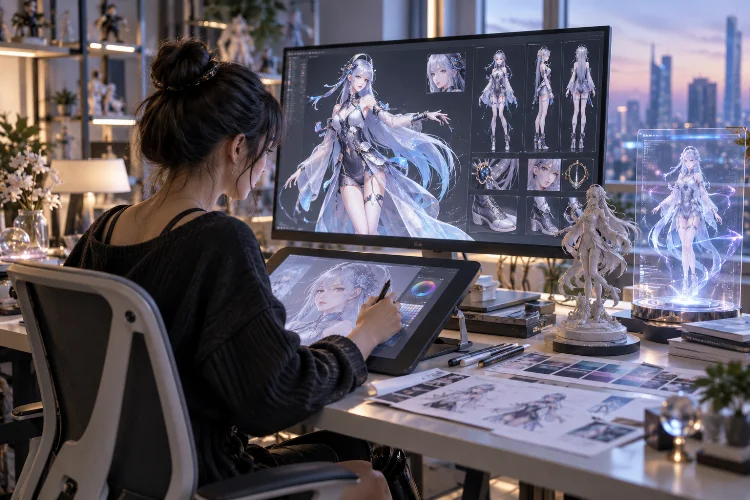
Imagine creating a digital character that can perform on virtual stages, release music, interact with thousands of fans, and develop a personality that audiences genuinely connect with.
Sounds like something from a futuristic movie, right?
Well, virtual idols are already making that vision a reality.
From animated performers to sophisticated 3D personalities, digital entertainers are becoming an increasingly interesting part of modern entertainment. They’re appearing in music videos, livestreams, interactive games, virtual concerts, and social media communities.
However, designing a successful virtual performer involves much more than drawing an attractive character or building a detailed 3D model.
Advanced virtual idol character design combines visual storytelling, character psychology, animation technology, digital production, and audience engagement into one creative process.
The challenge is making everything work together naturally.
A beautifully rendered character won’t accomplish much if its expressions feel lifeless or its personality lacks direction. Meanwhile, a relatively simple avatar can become memorable through expressive animation and meaningful interaction.
So, how do professional creators approach this process?
Let’s explore the creative strategies, technologies, and practical techniques behind compelling virtual idols.
1. Understanding the Foundations of Virtual Idol Character Design
Before opening your favorite design software, it’s important to understand what actually makes a virtual idol different from an ordinary animated character.
A traditional fictional character usually follows a predetermined storyline. A virtual idol, however, often maintains an ongoing public identity through performances, social interactions, and continuously evolving content.
Creating a Strong Character Identity
Every successful digital entertainer needs a recognizable identity.
This includes the character’s personality, interests, communication style, background story, and relationship with its intended audience. These details guide almost every creative decision that follows.
For example, imagine designing a futuristic electronic music performer.
You might give the character a confident personality, energetic body language, reflective clothing materials, and a slightly mysterious backstory. Together, these choices establish an identity that audiences can recognize.
Now imagine a virtual singer specializing in emotional acoustic music.
Soft colors, gentle facial expressions, relaxed movements, and a thoughtful communication style would probably create a more appropriate experience.
Neither approach is automatically better. The important thing is consistency between visual presentation and personality.
Developing a Character Design Bible
Professional creative teams often benefit from building a character design bible before production begins.
This document establishes the character’s appearance, personality traits, visual references, performance behavior, and storytelling boundaries.
It should also describe how the character behaves in different situations.
How does the idol greet fans? What happens when something goes wrong during a livestream? Does the character respond with humor, confidence, or quiet awkwardness?
These seemingly small decisions create a consistant identity across different entertainment platforms.
A well-defined character bible also helps illustrators, animators, writers, and performers collaborate without constantly reinventing the character.
2. Building a Distinctive Visual Identity That Audiences Remember
Let’s be realistic: people often notice a virtual idol’s appearance before discovering its personality.
That’s why visual identity plays such an important role in digital character development.
However, memorable design doesn’t necessarily mean adding complicated accessories, elaborate costumes, or hundreds of visual details.
Sometimes, simplicity makes a character more recognizable.
Silhouette and Shape Language
One of the most effective character design techniques is developing a strong silhouette.
Try viewing your character as a completely black shape against a white background. Can you still recognize its hairstyle, posture, or costume structure?
If the answer is yes, you’re moving in the right direction.
Distinctive hair shapes, oversized jackets, unusual accessories, and carefully designed proportions can establish visual recognition without relying on facial details.
Shape language also influences personality.
Rounded forms often communicate friendliness and approachability, while angular shapes may suggest energy, confidence, or intensity. Mixing these visual elements can create more complex personalities.
Color Psychology and Costume Design
Color choices should support the character’s emotional identity and entertainment genre.
A playful pop idol might feature bright complementary colors, while a cyberpunk performer could use darker tones with selective neon accents.
Rather than using every attractive color available, establish a controlled palette.
A practical approach is selecting one dominant color, one supporting color, and one accent color. These proportions can change depending on costumes, environments, and promotional artwork.
Costume design deserves equal attention.
Clothing must look attractive while allowing believable movement during dancing, singing, and interactive performances.
For advanced character customization, consider modular costume systems that allow hairstyles, accessories, and clothing pieces to change without rebuilding the entire model.
This flexibility becomes especially valuable for seasonal events, concerts, and promotional collaborations.
3. Choosing the Right 2D and 3D Character Production Techniques
One of the biggest creative decisions involves choosing between 2D and 3D character production.
Both approaches can produce outstanding digital entertainers, but their technical requirements and visual possibilities are different.
Advanced 2D Modeling With Live2D
Live2D technology allows artists to animate illustrated characters while preserving their original drawing style.
Instead of rebuilding the character as a traditional 3D object, creators separate illustrations into movable layers.
These layers can include eyes, eyebrows, hair sections, facial features, clothing, and accessories.
According to the official Live2D production workflow, artists prepare separated illustration assets, create deformers and movement parameters, and develop animations using the resulting model.
The technique is particularly useful for anime-inspired idols and livestreaming personalities.
A character can blink, smile, turn its head, and respond to facial tracking while maintaining a hand-drawn appearance.
However, complicated movements may require additional preparation because the original artwork doesn’t contain complete three-dimensional geometry.
Developing Fully Realized 3D Characters
Three-dimensional production provides greater freedom for cinematic performances and interactive environments.
Artists commonly use software such as Blender, Maya, or other digital content creation tools to sculpt models, build materials, and prepare animation-ready geometry.
The process generally includes modeling, UV mapping, texturing, skeletal rigging, and animation testing.
For stylized performers, carefully controlled topology is particularly important around the face, shoulders, elbows, and knees.
Poor geometry can produce unnatural deformation during expressive movements.
Realistic digital humans introduce additional challenges, including skin shading, eye behavior, facial microexpressions, and believable lighting.
Tools such as Unreal Engine’s MetaHuman framework can support advanced facial animation and digital-human production.
Selecting a Production Approach
The best option depends on the character’s intended activities.
A conversational anime-style streamer may work beautifully with a sophisticated 2D model. Meanwhile, a virtual dance group performing complex choreography may benefit from a complete 3D production pipeline.
Some entertainment projects even combine different representations of the same character.
For instance, an idol might use a lightweight illustrated avatar for casual streaming and a detailed 3D model for major concert performances.
The important thing is preserving recognizable character traits across both versions.
4. Creating Expressive Animation and Natural Character Movement
An impressive character model is only the starting point.
What really brings a virtual idol to life is movement.
Facial expressions, gestures, dancing, and subtle reactions communicate personality in ways that static illustrations simply cannot.
Advanced Facial Rigging and Expression Systems
Facial rigging determines how a digital character communicates emotion.
For 3D models, artists frequently use blend shapes, skeletal controls, or hybrid systems to manipulate facial features.
Blend shapes allow a mesh to transition between different expressions, such as smiling, blinking, raising eyebrows, or opening the mouth.
Advanced setups can combine multiple expressions to produce more nuanced performances.
However, technical complexity alone doesn’t guarantee believable animation.
Timing matters just as much.
A smile that develops gradually can feel warmer than an instant facial change. Likewise, slight eye movements and delayed head reactions can make conversations more engaging.
These details are often more effective than exaggerated facial movements.
Motion Capture and Performance Tracking
Motion capture allows creators to translate human performances into digital animation.
Facial tracking can reproduce expressions, while body tracking records larger movements such as walking, dancing, and gesturing.
Epic Games’ MetaHuman Animator documentation describes workflows using video, audio, and depth-based performance capture for real-time or offline animation.
Meanwhile, NVIDIA’s Audio2Face technology demonstrates how audio-driven systems can generate facial animation and lip synchronization.
These tools can reduce repetitive animation work, although artists still need to review and refine the results.
For example, automated lip movements might match spoken words but miss the emotional intensity of a dramatic performance.
Manual adjustments can help restore those expressive details.
Adding Secondary Motion
Hair, clothing, jewelry, and accessories should respond naturally to movement.
These secondary animations create a stronger sense of weight and physical presence.
However, excessive physics can make a character appear unstable or distracting.
A balanced rig should support the primary performance rather than compete with it.
For virtual concerts, test animations under realistic stage lighting and camera angles. Movements that look fantastic in a modeling viewport may behave differently during an actual show.
5. Designing Voice, Music, and Performance Personality
A virtual idol isn’t just a digital model with an attractive face.
For music-focused entertainment, voice and performance style are equally important parts of the character.
Establishing a Recognizable Vocal Identity
A character’s voice should match its personality without becoming predictable.
A cheerful virtual idol might speak quickly with playful intonation, while a mysterious performer could use slower pacing and more deliberate phrasing.
Creators can develop vocal performances through human voice actors, licensed singing synthesis, or carefully managed AI-assisted voice technologies.
Each method has advantages and limitations.
Human performers provide natural emotional interpretation, while synthesized vocals offer opportunities for unusual sounds and flexible musical experimentation.
AI-assisted tools may help with production, but they should be used with appropriate consent and clearly defined rights.
Connecting Vocal Performance With Animation
Voice and facial animation should feel like parts of the same performance.
If a character delivers an emotional lyric while maintaining a neutral expression, the disconnect becomes immediately noticeable.
A practical solution involves designing coordinated performance cues.
During an intense chorus, the character might raise its eyebrows, lean forward, and use stronger gestures. During quieter passages, smaller head movements and softer expressions may work better.
Music production, choreography, facial animation, and camera direction should therefore be planned together.
This coordination creates more expresive performances without requiring unnecessarily complicated animation.
Learning From Established Virtual Performers
Virtual entertainment offers useful examples of different production philosophies.
Hatsune Miku demonstrates how a recognizable singing character can become the center of a broad creative community.
Meanwhile, virtual K-pop projects such as MAVE: show how digital performers can combine music, choreography, styling, and carefully developed fictional identities.
The lesson isn’t to copy their appearances.
It’s to understand how music, character identity, and visual presentation reinforce each other.
6. Designing Interactive Experiences and Strong Fan Communities
One of the most exciting aspects of virtual entertainment is the opportunity to build ongoing relationships between digital performers and audiences.
Fans aren’t simply watching a fictional character appear in a finished animation.
They may follow livestreams, participate in online events, contribute artwork, and influence future creative decisions.
Making Character Interaction Feel Authentic
Natural interaction starts with consistent behavior.
A virtual idol should have recognizable preferences, conversational habits, and emotional responses.
If the character suddenly changes personality between platforms without a narrative explanation, the experience can feel artificial.
Creators should also distinguish between scripted interactions, human-operated performances, and automated responses.
Not every virtual idol uses artificial intelligence. Many rely on real performers who control avatars through tracking technology.
When AI systems are involved, transparency helps audiences understand the experience.
Building Emotional Connections Through Storytelling
A compelling virtual persona needs more than a fictional biography.
Audiences often connect through recurring experiences, personal goals, and recognizable character development.
For example, a virtual singer might begin as an inexperienced performer preparing for a first concert.
Over time, viewers follow rehearsals, musical releases, costume changes, and increasingly ambitious performances.
This provides a narrative framework for audience participation.
A 2026 study published in Psychology & Marketing analyzed 16,583 YouTube videos from virtual and human idol groups. Its findings highlighted relationships between emotional expression, content context, and audience engagement.
The practical takeaway is that character emotions should suit the situation rather than remain permanently cheerful.
Encouraging Creative Participation
Fan communities can contribute significantly to a digital performer’s identity.
Artwork challenges, music remixes, interactive polls, and community events allow audiences to participate creatively.
However, contributions should follow clear guidelines covering attribution, moderation, and commercial use.
Creators should also avoid making participation feel like an obligation.
A healthy entertainment community gives fans opportunities to connect without demanding constant attention or spending.
Ultimately, sustainable engagement grows from memorable experiences, not endless promotional messages.
7. Optimizing Virtual Idol Production for Long-Term Success
Even the most creative character concept needs a practical production strategy.
Virtual idols frequently appear across different platforms, including streaming applications, video services, interactive environments, and mobile devices.
Each platform introduces different technical requirements.
Performance Optimization and Cross-Platform Compatibility
Highly detailed models can create performance problems when used in real-time applications.
Complex shaders, oversized textures, unnecessary geometry, and excessive physics calculations may increase hardware demands.
For 3D characters, creators can use multiple levels of detail, optimized materials, and carefully managed animation systems.
The VRM avatar format also provides a useful approach for transporting humanoid character data between compatible applications.
However, compatibility still depends on the destination software and supported features.
For 2D characters, reducing unnecessary deformers and managing texture sizes can help maintain smoother animation.
Always test the final asset in its intended enviroment rather than relying exclusively on preview software.
A practical quality checklist should cover facial tracking, animation stability, audio synchronization, rendering performance, and readability on smaller screens.
Protecting Intellectual Property and Creative Rights
Digital performers can involve multiple layers of intellectual property.
Character illustrations, 3D models, music, recordings, voice performances, and animation files may have different owners.
That’s why written agreements are essential when working with freelance artists, voice actors, musicians, or external studios.
These agreements should explain licensing, commercial usage, attribution, modifications, and long-term ownership.
For example, Crypton Future Media publishes specific creator guidelines for Hatsune Miku and related characters, including restrictions on commercial use of certain licensed illustrations.
This demonstrates why creators shouldn’t assume that publicly accessible character assets are automatically free for commercial projects.
Privacy and performer consent also matter, especially when motion capture or voice recordings are involved.
Building an Efficient Creative Workflow
An efficient production pipeline reduces unnecessary revisions and allows teams to improve characters systematically.
Start with a concept brief, develop reference sheets, create a basic model, and test its most important expressions before adding elaborate details.
Then introduce animation, performance systems, clothing variations, and platform-specific features.
Collect feedback at each stage.
If viewers struggle to recognize expressions on mobile devices, prioritize facial readability before adding more visual complexity.
If hair physics repeatedly breaks during choreography, simplify the simulation rather than endlessly adjusting individual animations.
Finally, monitor meaningful performance indicators such as audience retention, repeat viewership, fan participation, and content production costs.
These measurements can help guide future creative investments.
Advanced virtual idol character design is about creating more than a visually impressive digital personality.
The strongest virtual entertainers combine memorable aesthetics, consistent characterization, expressive animation, engaging performances, and thoughtful audience interaction.
Whether you’re developing a 2D anime-style singer or a sophisticated 3D digital performer, every technical decision should support the character’s identity and purpose.
Remember that expensive technology doesn’t automatically produce meaningful entertainment. Creative direction, storytelling, and attention to detail often make the biggest difference.
Start with a clear concept, build a manageable production workflow, and improve your character through practical testing and audience feedback.
Ready to create your own virtual idol? Begin by developing a character concept and visual identity, then experiment with the animation tools that best support your creative vision.
Your next digital star could begin with a single sketch.
