
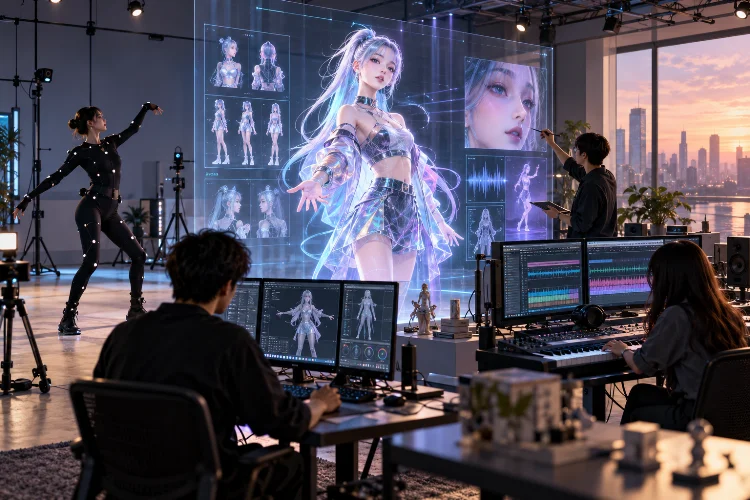
Imagine creating a virtual pop star who can sing original songs, perform realistic dance moves, interact with fans, and develop a recognizable personality without ever stepping onto a physical stage.
Sounds like something from a science fiction movie, right?
Well, artificial intelligence is making parts of that vision increasingly achievable.
Not long ago, building a professional virtual idol required talented illustrators, animation specialists, voice performers, music producers, and significant production resources.
Today, AI-powered creative tools can assist with everything from character concepts and vocal synthesis to facial animation and interactive conversations.
And that’s changing the entertainment industry in some pretty exciting ways.
From virtual K-pop groups to independent digital performers, creators are experimenting with new ways to combine technology, storytelling, and musical entertainment.
But AI isn’t simply replacing traditional creative work. It’s also introducing new production methods, artistic possibilities, and questions about authenticity.
Understanding how artificial intelligence is reshaping virtual idol creation reveals why digital entertainment is evolving so quickly and what this transformation means for artists, developers, and fans.
Let’s explore how it all works.
1. How Artificial Intelligence Is Transforming Virtual Idol Production
From Traditional Animation to AI-Assisted Creation
Creating a virtual performer used to involve a complicated production process.
Artists designed the character, modelers created digital assets, animators developed movements, and performers supplied voices or motion-capture data.
Every stage required specialized knowledge.
That process still exists, especially in professional virtual entertainment, but AI now offers additional ways to complete certain tasks.
Generative design systems can produce visual concepts, machine learning models can assist with animation, and voice synthesis software can transform written lyrics into singing.
Instead of replacing an entire production team, these tools can reduce the amount of repetitive work involved in developing digital characters.
For independent creators, this is particularly significant.
Someone working with limited resources can experiment with character appearances, vocal styles, and promotional concepts before investing in expensive final assets.
However, an important distinction often gets overlooked.
Not every virtual idol is powered by artificial intelligence.
Some digital performers use human singers and actors whose movements appear through animated avatars.
For example, Reuters reported in May 2025 that the members of the virtual K-pop group PLAVE perform through human-controlled avatars using motion-capture technology rather than AI-generated performances.
This distinction matters because virtual entertainment includes several production models, ranging from human-operated characters to AI-assisted and highly automated personalities.
AI Changes the Creative Workflow
The biggest transformation isn’t necessarily that computers can generate content.
It’s how quickly creators can explore different ideas.
Imagine developing a futuristic virtual singer inspired by cyberpunk fashion and traditional Japanese aesthetics.
Previously, testing five different character directions might require extensive illustration work.
An AI-assisted workflow can generate preliminary concepts for comparison, helping an artist identify promising visual directions.
The final design still benefits from professional refinement, originality checks, and consistent character modeling.
In this environment, AI becomes a creative assistant rather than an automatic replacement for human imagination.
2. AI Character Design Makes Virtual Idol Development More Flexible
Generating Visual Concepts With AI
One of the most accessible applications of generative technology is character concept development.
Image-generation models can help creators explore hairstyles, costumes, facial features, accessories, and environmental themes.
Instead of beginning with a completely blank canvas, designers can experiment with combinations of visual elements.
For instance, a virtual idol inspired by celestial mythology might feature luminous clothing, star-shaped ornaments, and futuristic stage equipment.
AI tools can generate rough variations based on those creative directions.
The artist can then select appealing elements and develop a unique character identity.
However, generated illustrations shouldn’t automatically become final production assets.
AI images may contain inconsistent details, unrealistic anatomy, or designs that are difficult to reproduce across multiple poses.
Human artists remain valuable for turning experiments into recognizable, production-ready characters.
Creating Consistent Character Identities
Visual consistency is essential in virtual idol branding.
A character needs to remain recognizable across music videos, livestreams, merchandise, promotional posters, and social media content.
That becomes difficult when AI produces slightly different facial features or clothing details in every image.
Creators can address this challenge through approved reference sheets, carefully controlled generation methods, and manually refined master designs.
A reference sheet typically includes facial proportions, hairstyle details, color palettes, clothing variations, and signature accessories.
AI can support the exploration process, but consistency usually requires additional artistic control.
The goal is to create a character audiences can recognize instantly.
Personality Development Beyond Appearance
Interestingly, artificial intelligence can also help creators explore fictional personalities.
Language models can assist with brainstorming backstories, dialogue examples, emotional motivations, and character relationships.
Imagine developing a virtual singer who appears confident on stage but struggles with making friends.
AI-assisted brainstorming might suggest situations that reveal these contrasting personality traits.
The creator can decide which ideas fit the character’s intended identity.
This combination of technological assistance and human storytelling makes character development more flexible without surrendering creative direction.
3. AI Voice Synthesis Is Revolutionizing Virtual Idol Music
Creating Digital Singing Voices
Music is one of the most important elements of virtual idol entertainment.
A memorable singing voice can become a character’s defining feature.
Modern AI-powered vocal synthesis allows producers to generate singing from lyrics and melodies, depending on the capabilities of the software.
These systems can help control pronunciation, timing, pitch transitions, vocal expression, and certain performance characteristics.
A notable example is <Entity category=”software” value=”VOCALOID6″ disambig=”Yamaha singing voice synthesis software”/>.
Yamaha introduced AI-based singing synthesis with VOCALOID6 in 2022, allowing producers to create more natural and expressive vocal performances.
On April 14, 2026, Yamaha also announced the release of the HATSUNE MIKU V6 voicebank.
The updated software supports AI-assisted vocal expression, including automatic breath generation and editable vocal characteristics.
This highlights how established virtual singing technology continues to evolve through machine learning.
AI-Assisted Music Production
Beyond singing, generative AI can support several stages of music production.
Composers may use creative software to explore melodies, draft arrangements, develop harmonic ideas, or experiment with instrumental textures.
For example, an independent producer creating an energetic electronic pop song might begin with a manually written chorus.
AI tools could help generate alternative arrangement ideas or suggest different instrumental combinations.
The producer would still need to evaluate musical quality, artistic direction, and originality.
This approach can accelerate experimentation without necessarily removing human involvement.
And that’s where the real opportunity lies.
AI can help creators explore more possibilities, but artistic judgment determines which ideas deserve to become finished songs.
Why Human Musical Direction Still Matters
Generating a technically acceptable song doesn’t guarantee an emotionally memorable performance.
Fans often connect with distinctive melodies, meaningful lyrics, unusual production choices, and recognizable artistic identities.
A virtual idol needs more than a collection of randomly generated tracks.
Their music should reflect their character.
A rebellious cyberpunk performer might favor aggressive electronic sounds, while a gentle fantasy-inspired singer could develop a softer musical identity.
Maintaining that relationship between personality and sound helps build a cohesive entertainment experience.
Without creative direction, even technically impresive AI-generated vocals may feel generic.
4. AI Animation and Motion Technology Create More Realistic Performances
Smarter Facial Animation and Lip Synchronization
A virtual idol’s facial expressions influence how believable their performances feel.
Smiles, eyebrow movements, blinking, and subtle changes in expression can communicate emotion.
Traditionally, animators manually adjusted many of these details or captured them using specialized equipment.
AI-assisted systems introduce additional options.
In September 2025, NVIDIA announced the open-source release of its Audio2Face technology, which generates facial animation using audio input.
The system analyzes speech characteristics to produce animation data that can be connected to a digital character.
This technology is especially interesting for virtual entertainment because natural-looking facial movement can improve the connection between a character’s voice and appearance.
However, realistic animation still depends on suitable character models, technical integration, and artistic refinement.
Combining AI With Motion Capture
Motion capture remains an important technology in virtual performance.
Human actors wear tracking equipment or use camera-based systems that record body movements.
Those movements are transferred to digital avatars.
AI can complement this process through motion cleanup, animation adjustment, tracking assistance, or procedural movement generation.
Imagine a virtual idol performing an elaborate dance routine.
A choreographer could develop the original movements, performers could capture the choreography, and software could assist with correcting imperfect tracking data.
This workflow combines human performance with digital processing.
It also demonstrates why artificial intelligence and motion capture shouldn’t be treated as identical technologies.
They solve different problems, although they can work together.
Building More Dynamic Virtual Stages
AI-assisted production is also expanding how creators approach digital environments.
Instead of using the same background for every performance, virtual idols can appear in imaginative worlds tailored to individual songs.
A concert might take place inside a floating city, an underwater palace, or a futuristic space station.
Generative tools can assist with initial environmental concepts, textures, lighting experiments, and visual effects.
Meanwhile, game engines and real-time rendering systems bring those environments into animated performances.
The creative possibilities are enormous.
Still, high-quality interactive concerts require careful optimization and technical planning, especially when livestreaming to large audiences.
5. Conversational AI Is Changing Virtual Idol Fan Relationships
From Scripted Messages to Interactive Personalities
One of the most fascinating developments involves AI-powered conversations.
Traditional virtual characters typically rely on prerecorded dialogue, human-operated livestreams, or carefully scripted interactions.
Conversational AI introduces another possibility.
A digital personality can interpret audience questions and generate context-sensitive responses in real time.
For example, fans might ask a fictional virtual idol about their favorite music, upcoming performances, or imaginary hometown.
A language model can generate answers using an approved character profile and supporting knowledge base.
This creates a more flexible interaction than a small collection of prerecorded responses.
However, creators still need safeguards to prevent inaccurate information, inappropriate dialogue, and contradictions with established character lore.
Can AI Personalities Develop Emotional Connections?
Fans can develop emotional attachments to fictional characters, virtual performers, and interactive digital personalities.
These connections are often discussed through the concept of parasocial relationships.
A 2026 study published in Social Sciences examined relationships involving AI-customized virtual idols.
The researchers explored how generative systems can support evolving character traits and communication patterns through audience interaction.
The study highlights an important direction for virtual entertainment: character experiences can become more participatory and personalized.
That doesn’t mean every AI-generated conversation creates a meaningful relationship.
Emotional connection depends on factors such as trust, consistency, personal expectations, and the wider fan community.
Making Digital Interactions Feel Natural
Developers can improve conversational experiences through carefully designed character behavior.
A shy personality might respond with hesitation, while an energetic idol may use playful expressions and enthusiastic greetings.
Consistant communication helps audiences recognize the same character across different interactions.
Some systems may also use approved conversational memory to maintain continuity over time.
For example, a virtual performer could remember a community-approved nickname or reference an earlier fictional event.
Personal information should only be retained with appropriate consent, privacy protections, and clear disclosure.
Most importantly, creators should explain when fans are interacting with an AI system rather than a human performer.
Transparency supports healthier expectations and long-term trust.
6. AI Is Opening New Opportunities for Independent Virtual Idol Creators
Lowering Some Creative Barriers
Producing professional digital entertainment can be expensive.
Character modeling, music production, animation, technical infrastructure, and promotional content all require resources.
AI-assisted tools may help smaller teams complete selected tasks more efficiently.
A solo creator could experiment with visual concepts, draft promotional copy, create vocal demonstrations, and test dialogue ideas before hiring specialists.
This makes early creative exploration more accessible.
However, launching a successful virtual idol still involves financial commitments.
Commercial licenses, computing resources, software subscriptions, skilled collaborators, and ongoing content production can become costly.
AI reduces some barriers without eliminating the need for investment.
Building a Practical AI-Assisted Production Workflow
Consider an independent creator planning to launch a fantasy-themed virtual singer.
The project begins with a clear creative brief describing the character’s appearance, personality, musical genre, and target audience.
Generative tools can assist with early character concepts, but the creator selects and refines a distinctive final design.
Next comes vocal development.
A properly licensed singing voicebank or authorized voice model can provide vocal demonstrations while the producer develops original songs.
The character then needs animation assets, performance software, and a consistent visual presentation.
After preparing several finished content pieces, the creator can test audience reactions through short videos or a small livestream.
This gradual approach is generally more manageable than attempting to launch a fully interactive digital celebrity immediately.
New Opportunities for Creative Collaboration
AI doesn’t necessarily mean fewer people are involved in entertainment production.
It can also change how creative teams collaborate.
Illustrators might focus more on distinctive visual identities, while programmers develop real-time interaction systems.
Writers can design character narratives, musicians can refine original compositions, and animators can create expressive performances.
The technology may handle some repetitive or exploratory tasks, giving specialists more opportunities to focus on complex creative decisions.
Of course, the effects on employment and professional opportunities will differ across industries and production environments.
The most promising workflow is one where technology supports meaningful human creativty rather than treating artistic expertise as disposable.
7. Ethical Challenges and the Future of AI Virtual Idols
Copyright and Ownership Questions
As AI becomes more involved in digital entertainment, intellectual property becomes increasingly important.
Who owns an AI-generated character design?
Can a synthetic singing voice be used commercially?
What happens when generated content resembles an existing performer?
These questions don’t always have simple answers.
In January 2025, the U.S. Copyright Office published guidance explaining that copyright protection for AI-related outputs depends on sufficient human authorship.
Simply entering prompts does not automatically establish copyright protection over purely AI-generated expressive content.
However, meaningful human creative contributions, arrangements, or modifications can potentially qualify for protection.
Rules differ between jurisdictions, so creators should evaluate the laws relevant to their projects.
Using properly licensed training materials, commercial assets, and vocal technologies can help reduce legal uncertainty.
Voice Cloning and Performer Consent
AI voice cloning creates additional ethical concerns.
Modern systems can imitate certain vocal characteristics, sometimes making synthetic speech difficult to distinguish from authentic recordings.
For virtual idol creators, this technology can offer interesting opportunities when performers provide informed consent.
A singer might authorize the development of a digital voice for a fictional character under a clearly defined licensing agreement.
Problems emerge when someone reproduces another person’s voice without permission.
Unauthorized imitations can create reputational harm, confusion, and potential legal disputes.
Responsible creators should obtain consent, document usage rights, and avoid misleading audiences about who performed or generated the audio.
Transparency Is Becoming More Important
Audiences increasingly want to understand how digital entertainment is produced.
In July 2026, IFPI and several music industry organizations announced a voluntary labeling initiative distinguishing AI-generated recordings from AI-assisted recordings.
The initiative reflects growing interest in communicating how generative technology contributes to musical content.
For virtual idol creators, similar transparency can help establish trust.
Fans should be able to understand whether a character is human-operated, AI-assisted, or primarily automated.
Clear communcation doesn’t have to ruin the magic of fictional storytelling.
Instead, it helps people appreciate the creativity and technology involved.
What Comes Next for Virtual Entertainment?
Future virtual idols may combine increasingly sophisticated conversational models, expressive animation, multilingual communication, and interactive storytelling.
Imagine attending a digital concert where the performer reacts to audience participation and adjusts parts of the experience in real time.
Fans might explore fictional environments connected to the idol’s backstory or participate in community-driven narrative events.
More advanced systems could also make personalized content easier to develop.
However, these possibilities come with challenges involving technical reliability, content moderation, privacy, consent, and production costs.
The most compelling future probably won’t involve eliminating human creativity.
It will involve discovering how people and intelligent software can collaborate to produce entertainment experiences that previously seemed impossible.
Artificial intelligence is transforming virtual idol production by expanding what’s possible in character design, music generation, animation, storytelling, and audience interaction.
Creators can now experiment with sophisticated digital performances using tools that were previously unavailable or difficult to access.
However, technology alone doesn’t create memorable entertainment.
Successful virtual performers still need distinctive personalities, engaging music, visual consistency, creative direction, and genuine respect for their audiences.
Copyright, transparency, and performer consent will also become increasingly important as AI-assisted entertainment develops.
The biggest opportunity isn’t simply creating digital celebrities faster. It’s building original experiences that combine technical innovation with meaningful artistic expression.
Interested in creating your own AI-powered virtual idol? Start with a strong character concept, explore suitable creative tools, and use artificial intelligence to support a vision that’s genuinely yours.
