
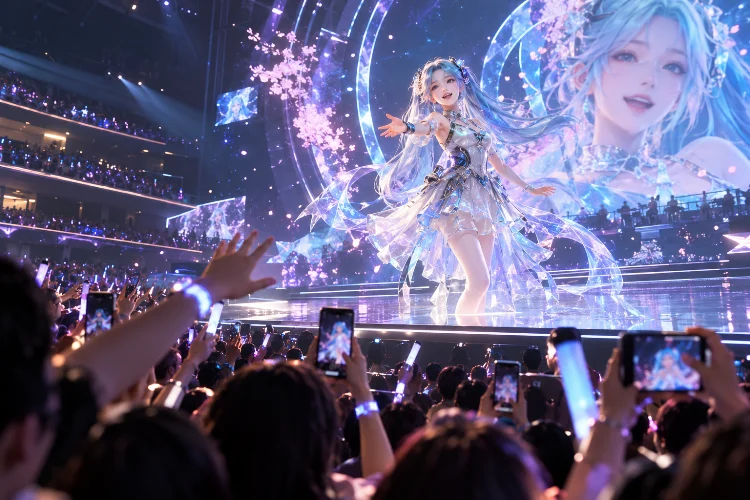
Imagine watching a virtual idol perform live, asking them a question in the chat, and receiving a personalized response almost immediately.
Now imagine that same digital performer remembering your favorite song, reacting to your comments with expressive facial animations, and adjusting its behavior based on what’s happening during the performance.
Pretty futuristic, right?
Well, artificial intelligence is making these experiences increasingly possible.
Virtual idols are evolving beyond animated characters that simply perform scripted songs or follow predetermined conversations.
With modern AI technologies, digital entertainers can communicate through voice, respond to audience input, and participate in interactive virtual environments.
However, creating these experiences requires more than connecting a chatbot to an animated avatar.
Advanced AI systems for interactive virtual idol experiences combine natural language processing, real-time speech technology, animation engines, contextual memory, and intelligent interaction management.
When these components work together effectively, audiences can enjoy digital performances that feel more responsive, entertaining, and personally relevant.
In this guide, we’ll explore the technologies, development strategies, and practical considerations behind building intelligent virtual idols for modern digital entertainment.
1. Understanding the Architecture of AI-Powered Virtual Idols
Before exploring sophisticated features, it’s important to understand how an AI-powered virtual performer actually works.
Unlike traditional animated characters, intelligent digital idols often rely on multiple interconnected systems.
Each component handles a different part of the experience, from understanding audience messages to generating voice responses and controlling facial expressions.
The Core Components of an Interactive AI Idol
A typical AI virtual idol architecture includes a conversational intelligence system, an audio-processing layer, a character animation engine, and an interaction management system.
The conversational system interprets questions and generates appropriate responses.
Meanwhile, the audio layer handles speech recognition and voice generation. The animation engine coordinates expressions, lip movements, and gestures with the generated dialogue.
An orchestration layer connects everything and determines what should happen next.
For example, imagine a virtual singer named Luna Nova hosting an interactive concert.
A fan asks Luna to explain the inspiration behind her latest song.
The system identifies the question, retrieves relevant information from the character’s approved background material, and produces an answer consistent with Luna’s personality.
The response is then converted into speech while her avatar performs synchronized facial movements.
This sequence creates the impression of a unified digital personality, even though several technologies are working behind the scenes.
Why Modular AI Architecture Matters
Separating these components makes virtual idol development more flexible.
Creators can improve the voice system without completely rebuilding the animation engine.
Likewise, an existing character model can potentially support different conversational technologies.
NVIDIA’s digital human architecture demonstrates this modular approach by combining speech recognition, language processing, speech synthesis, and audio-driven facial animation.
For independent creators, a modular workflow also helps control technical complexity.
Instead of building every feature simultaneously, developers can start with a simple text-based character and gradually introduce more advanced capabilities.
2. Building Real-Time Conversational AI for Natural Interactions
One of the biggest challenges in interactive virtual entertainment is making conversations feel natural.
Audiences don’t want to interact with a digital performer that responds several seconds too late or constantly repeats generic dialogue.
They expect conversations to flow smoothly.
Using Large Language Models for Character Conversations
Large language models, or LLMs, allow virtual characters to interpret natural language and generate contextually relevant responses.
These systems can support casual conversations, fan questions, fictional storytelling, and interactive entertainment activities.
However, a general-purpose language model doesn’t automatically understand a character’s personality.
Developers need to provide detailed instructions that establish the idol’s communication style, fictional background, and behavioral boundaries.
For example, Luna Nova might be programmed to speak enthusiastically about music, use playful humor, and reference her fictional adventures.
Her conversational guidelines should also explain how she responds when she doesn’t know something.
Rather than inventing an answer, Luna could acknowledge the uncertainty while remaining in character.
This helps preserve both personality consistency and factual reliability.
Implementing Low-Latency Speech Interaction
Real-time voice technology is another essential component.
OpenAI’s Realtime API documentation describes speech-to-speech interactions that support conversational state, voice activity detection, and interruption handling.
Google’s Gemini Live API offers real-time audio interactions with features designed for continuous conversations and streaming responses.
These technologies illustrate how virtual idols can move beyond traditional text-based chat.
For example, fans could speak directly to Luna during a virtual meet-and-greet.
The system would process incoming audio, interpret the request, and generate a spoken response.
The overall experience depends heavily on latency, which is the delay between an audience member’s input and the character’s response.
Managing Interruptions and Conversation Flow
Natural conversations rarely follow perfectly structured turns.
People interrupt, change subjects, and ask follow-up questions.
An effective AI interaction system should recognize these situations without becoming confused.
Voice activity detection can help identify when someone starts or stops speaking.
Developers must also manage audio buffers so that outdated responses stop playing when conversations are interrupted.
Google’s Live API best-practice documentation specifically discusses streaming audio in small chunks and clearing buffered audio after interruptions.
These seemingly technical details can make an enormous difference.
A virtual performer that smoothly handles interruptions feels more responsive than one that continues talking over its audience.
3. Developing Intelligent Character Personalities and Memory Systems
A virtual idol becomes more interesting when it has a recognizable personality.
However, maintaining that personality across thousands of conversations introduces challenges.
Without structured character information, AI-generated responses may gradually contradict established stories or behavioral traits.
Creating AI Personality Frameworks
Start by defining the character’s essential personality characteristics.
These might include humor, confidence, curiosity, emotional expressiveness, and conversational preferences.
Then translate these characteristics into practical behavioral instructions.
For example, Luna might be optimistic, slightly mischievous, and deeply passionate about electronic music.
Her instructions could encourage playful jokes while discouraging aggressive or insulting language.
Developers should also establish consistent fictional facts.
If Luna’s story describes her as a musician from a futuristic city, she shouldn’t suddenly claim to have grown up in an unrelated setting.
A carefully maintained character database can help prevent these inconsistencies.
Using Retrieval-Augmented Generation
Retrieval-augmented generation, commonly called RAG, allows an AI system to access relevant information before generating responses.
Instead of relying entirely on information stored within the model, the system retrieves material from approved documents or databases.
For virtual idols, these sources might include character biographies, song descriptions, fictional timelines, event schedules, and official announcements.
Imagine a fan asking Luna about her first concert.
The retrieval system could locate the approved concert storyline and provide that information to the language model.
Luna could then respond in her established personality without inventing contradictory details.
This approach becomes particularly useful as a virtual idol’s fictional universe expands.
Implementing Contextual Memory
Memory systems can make interactions feel more connected over time.
A research paper titled Generative Agents: Interactive Simulacra of Human Behavior explored an architecture combining stored experiences, memory retrieval, reflection, and planning.
Although the research wasn’t specifically focused on virtual idols, these concepts provide useful inspiration.
Developers can distinguish between short-term conversation context and longer-term preferences.
Short-term memory helps Luna follow the current discussion.
Longer-term memory might store a fan’s voluntarily shared favorite music genre or preferred interaction language.
However, memory should never become an excuse for collecting unnecessary personal information.
Users should understand what information is saved and have meaningful options to review, correct, or delete it.
4. Creating Emotion-Aware Animation and Expressive Digital Performances
Even the smartest conversational AI can feel disappointing when connected to a character that barely moves.
Visual expression plays an important role in communicating personality.
Facial animation, gestures, body language, and synchronized movement all contribute to the experience.
Connecting AI Responses to Facial Animation
Modern avatar systems can translate audio and animation commands into expressive digital performances.
NVIDIA’s Audio2Face technology, for example, supports speech-driven facial animation.
Its animation pipeline documentation also describes mechanisms for controlling gestures, facial expressions, and character positioning.
For a virtual idol, this means generated dialogue can influence how the character appears on screen.
A cheerful response might trigger a smile and energetic movement.
A thoughtful response could involve slower gestures and a more relaxed expression.
However, the animation system shouldn’t exaggerate every emotional change.
Subtle movements often create a more believable result than constant dramatic reactions.
Working With 2D and 3D Avatar Systems
Different avatar formats require different animation strategies.
Live2D Cubism supports expression parameters and motion systems that allow illustrated characters to display controlled facial changes.
Its SDK documentation explains how expressions can modify existing parameter values and blend with other animations.
This makes it possible to create expressive anime-style characters without requiring complete 3D geometry.
Three-dimensional performers provide additional possibilities for body movement, choreography, and interactive positioning.
However, more complicated animation systems usually introduce greater development and rendering requirements.
Creators should select the format that supports their entertainment goals rather than automatically choosing the most technically advanced option.
Understanding Emotion Recognition Limitations
Some developers experiment with sentiment analysis to estimate whether audience messages are positive, negative, excited, or frustrated.
This can help influence character responses.
For example, a message celebrating a new music release might encourage Luna to respond enthusiastically.
However, AI systems cannot reliably determine someone’s complete emotional state from a short message.
Sarcasm, cultural differences, and ambiguous wording can easily produce incorrect interpretations.
Therefore, emotion-aware systems should treat emotional classifications as uncertain signals rather than unquestionable facts.
A good design uses sentiment cues to support natural interaction without pretending to understand every fan’s feelings.
5. Designing Personalized and Interactive Virtual Entertainment
Advanced AI becomes especially interesting when audiences can influence what happens during a performance.
Instead of watching a completely predetermined show, fans can participate in activities that change certain elements of the experience.
This creates opportunities for more engaging virtual entertainment.
Building Interactive AI Concerts
Imagine Luna Nova performing inside a futuristic digital concert hall.
During the show, audience members vote on which song should come next.
The system collects the votes and updates the planned setlist.
Luna then introduces the selected song through a combination of approved dialogue, contextual information, and optional AI-generated commentary.
Additional interactions might include choosing stage lighting themes, selecting visual effects, or participating in fictional story events.
However, not every concert component should be controlled by generative AI.
Music playback, licensing-sensitive material, and complex choreography may require carefully prepared content.
A hybrid production approach often provides greater reliability.
Personalizing Fan Experiences
Personalization can make digital entertainment feel more relevant.
A virtual idol might adjust its language, recommend songs based on stated preferences, or offer optional greetings during fan events.
However, meaningful personalization doesn’t require extensive behavioral tracking.
Creators can use voluntarily selected preferences instead.
For example, a fan could choose between an energetic conversation style and a relaxed backstage experience.
Luna’s system would adapt the interaction while preserving her core personality.
This gives audiences some control over their experience without requiring invasive data collection.
Integrating AI Into Games and Virtual Worlds
Virtual idols can also appear inside interactive gaming environments.
Rather than repeating the same dialogue, a character could respond to gameplay events or participate in fictional missions.
Imagine Luna appearing in a rhythm game.
She might congratulate players after completing a challenging song or offer contextual encouragement following a missed sequence.
An AI system could generate varied dialogue while approved game logic controls scoring and rewards.
This combination supports dynamic interaction without giving the language model unrestricted authority over gameplay systems.
6. Optimizing AI Virtual Idol Systems for Performance and Scalability
Sophisticated AI experiences can become technically expensive.
Speech processing, language generation, animation, and real-time networking all consume computational resources.
When thousands of viewers interact simultaneously, these requirements become even more challenging.
Reducing Latency and Processing Costs
One practical strategy is separating tasks according to their urgency.
Time-sensitive actions, such as facial animation or simple acknowledgments, should avoid unnecessary processing stages.
More complicated requests can be handled by seperate background services within the application architecture.
Developers may also use caching to avoid repeatedly generating identical approved information.
For example, Luna’s official concert schedule doesn’t need to be reconstructed through a language model every time someone asks about it.
A structured data source can provide the relevant answer.
The conversational system can then present the result in Luna’s established communication style.
Another useful approach involves selecting smaller models for straightforward classification tasks while reserving more capable models for complex dialogue.
Supporting Large Fan Communities
A livestream with several thousand viewers cannot realistically provide an individual spoken response to every message.
Developers need a system that prioritizes interactions.
This might involve selecting representative questions, grouping similar requests, and distinguishing routine comments from important event-related messages.
Audience moderation should operate before selected messages are displayed or converted into spoken dialogue.
For individual virtual meet-and-greet experiences, session limits and clear queue management can help maintain predictable performance.
Load testing is equally important.
A prototype might work perfectly for five simultaneous users but struggle when hundreds of people connect.
Testing should measure response latency, error rates, animation stability, and the cost of each interaction.
Measuring Interaction Quality
Technical performance is only one part of the equation.
Creators should also evaluate whether the character remains entertaining and consistant.
Useful metrics include conversation completion rates, returning participants, animation synchronization issues, and the frequency of incorrect or inappropriate responses.
For example, if users frequently interrupt Luna because her answers are too long, shorter dialogue may improve the experience.
Similarly, repeated questions about the same fictional event could indicate that the character’s explanations aren’t clear enough.
Evaluation should include both automated testing and human review.
A technically successful response isn’t necessarily a good entertainment experience.
7. Addressing AI Safety, Ethics, and Future Development
The increasing sophistication of virtual entertainers introduces important responsibilities.
When a digital character can speak naturally, remember conversations, and generate personalized responses, audiences may perceive it as more socially present.
Creators need to balance immersive entertainment with transparency and appropriate safeguards.
Establishing Responsible AI Interaction Policies
The U.S. National Institute of Standards and Technology provides an AI Risk Management Framework and a dedicated Generative AI Profile.
These resources identify risks involving reliability, privacy, harmful content, and other trust-related considerations.
For virtual idol development, responsible practices should begin during system design.
Audiences should be informed when they are interacting with AI-generated dialogue.
Creators should also establish rules for handling harassment, unsafe requests, and potentially harmful responses.
When voice technologies are involved, proper authorization from performers and voice owners is essential.
An AI character should not reproduce someone’s distinctive voice without appropriate permission.
Protecting Fan Privacy and Emotional Boundaries
Personalized AI interactions should respect audience privacy.
Developers should collect only the information needed to support clearly explained features.
Data retention periods, deletion options, and access controls should be established before introducing persistent memory.
It’s also important to avoid encouraging unhealthy emotional dependency.
A virtual idol can express warmth, gratitude, and appreciation without pretending to maintain exclusive personal relationships with individual fans.
For younger audiences, additional age-appropriate interaction limits may be necessary.
These boundaries help keep virtual entertainment enjoyable and trustworthy.
Exploring the Future of Intelligent Digital Performers
The next generation of virtual idols may combine stronger multimodal reasoning, more responsive animation, and increasingly interactive storytelling.
For example, future systems could allow a performer to react to approved environmental events inside a virtual concert venue.
They might also support collaborative storytelling where audience decisions influence a fictional adventure.
AI-assisted choreography planning and more expressive speech technologies could create additional creative possibilities.
However, these developments still face challenges involving cost, reliability, permissions, and emotional authenticity.
The most successfull projects won’t necessarily be those using the largest models or the most complicated technologies.
They’ll be the ones that combine reliable AI systems with thoughtful character design, strong creative direction, and genuinely enjoyable entertainment.
Advanced AI systems are transforming what’s possible in virtual entertainment.
By combining conversational intelligence, real-time speech processing, contextual memory, expressive animation, and interactive storytelling, creators can develop digital performers that respond dynamically to their audiences.
However, sophisticated technology alone doesn’t guarantee success.
A compelling virtual idol also needs a recognizable personality, consistent creative direction, reliable technical infrastructure, and responsible audience interaction policies.
The most effective approach is to start with a manageable character experience and gradually introduce intelligent features through careful testing.
Ready to develop your own AI-powered virtual idol? Begin with a clear character concept, experiment with real-time conversational tools, and build an interactive prototype that audiences can explore.
The future of digital entertainment isn’t simply about watching virtual characters perform. It’s about creating meaningful experiences where audiences become part of the performance.
