
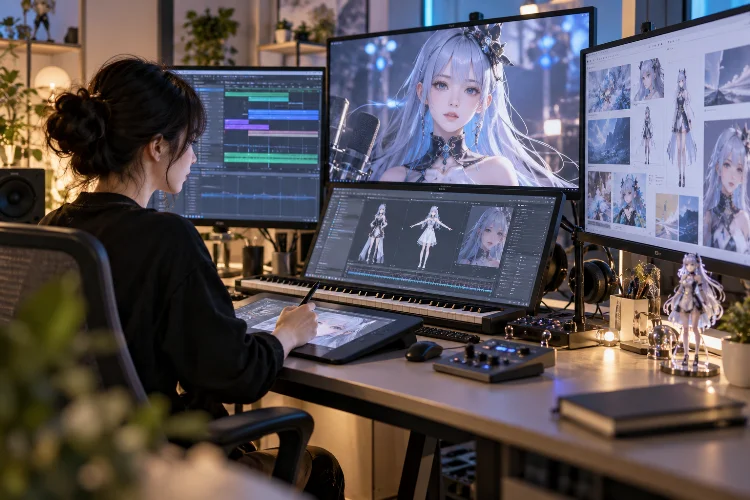
Imagine creating a virtual idol who can release original music, appear in animated performances, interact with fans, and maintain a recognizable personality across multiple platforms.
Now imagine producing much of that content without needing an enormous animation studio, a full-time writing department, or an expensive recording facility.
Sounds pretty exciting, right?
That’s exactly why generative artificial intelligence is becoming such an interesting part of digital entertainment production.
Integrating generative AI into virtual idol content production allows creators to experiment with character designs, generate creative concepts, develop scripts, produce audio, and streamline animation workflows.
However, the real opportunity isn’t simply replacing traditional creative processes with automated tools.
It’s about combining human creativity with intelligent technology to produce engaging entertainment more efficiently.
Whether you’re building an independent VTuber brand, launching an AI-powered virtual singer, or managing a digital entertainment studio, understanding how to integrate these technologies can make a meaningful difference.
In this guide, we’ll explore practical AI production techniques, creative workflows, character consistency, automation opportunities, and the challenges creators should consider before bringing their digital performers to life.
1. Understanding the Role of Generative AI in Virtual Idol Production
Virtual idol production traditionally involves several creative disciplines working together.
Character designers develop visual identities, writers establish personalities, musicians create original tracks, and animators transform digital models into performers.
Each stage requires time, coordination, and specialized expertise.
Generative AI introduces new ways to support these activities.
How AI Changes the Creative Workflow
Instead of developing every creative asset from scratch, production teams can use AI-assisted tools to generate initial concepts, explore variations, and automate selected repetitive tasks.
For example, a creator developing a futuristic virtual singer might use a language model to brainstorm backstories and an image-generation system to explore costume concepts.
Meanwhile, AI audio tools can assist with demo recordings, and animation software can translate speech into facial movements.
These technologies don’t eliminate the need for professional judgment.
Generated materials still require editing, refinement, technical adjustments, and creative approval before they’re suitable for publication.
The biggest advantage is often the ability to experiment with more ideas before committing resources to a final direction.
Choosing Where AI Adds Real Value
Not every production activity benefits equally from automation.
AI is particularly useful for early-stage ideation, drafting alternative concepts, generating temporary assets, and accelerating certain technical processes.
However, defining a character’s artistic identity, managing emotional storytelling, and maintaining audience trust require thoughtful human involvement.
A useful approach is to identify repetitive production bottlenecks rather than introducing AI everywhere immediately.
If writing promotional captions takes considerable time, text generation might be a sensible starting point.
If character animation is the biggest challenge, AI-assisted motion or lip-sync technology could provide more immediate value.
The goal is improving production quality and efficiency without sacrificing originality.
2. Using Generative AI for Character Design and Visual Identity
Visual identity is one of the most important elements of a successful virtual performer.
An appealing design helps attract attention, but maintaining recognizable features across music videos, social media posts, livestreams, and promotional artwork is equally important.
AI image-generation tools can support this process when used within a structured creative workflow.
Generate Character Concepts From Detailed Creative Briefs
Before creating visual assets, define the idol’s personality, fictional background, artistic direction, and target audience.
Imagine developing a virtual singer named Aria Nova, a digital musician who broadcasts from a floating observatory.
Her identity combines celestial imagery, electronic music, and a curious but slightly rebellious personality.
A creative brief might describe her silver-blue hair, distinctive crescent-shaped accessories, futuristic stage outfit, and deep navy color palette.
An image-generation model can help explore different interpretations of this concept.
However, random prompts often produce unrelated designs.
Providing reference materials, specific visual descriptions, and clear style guidelines increases the likelihood of obtaining useful results.
Maintain Character Consistency Across Assets
One of the biggest challenges in AI-generated artwork is visual inconsistency.
A character might look perfect in one image but appear completely different in another.
Facial proportions, hairstyles, accessories, clothing details, and even eye colors can change unexpectedly.
To reduce these problems, create a character reference sheet that establishes approved visual features.
Use those references whenever supported by the selected image-generation system, and maintain a library of approved poses, expressions, and costume designs.
Human artists should review important visual assets before they’re published.
Adobe’s official AI Studio guidance explains that its Firefly models are designed around commercially safer training sources, including licensed and public-domain materials.
Nevertheless, creators should review the specific model’s terms, particularly when working with third-party generation services.
A professional workflow combines visual experimentation with appropriate licensing checks and manual refinement.
3. Developing AI-Assisted Storytelling and Content Scripts
Virtual idols need more than attractive digital appearances.
They also need memorable personalities, interesting motivations, and engaging communication styles.
This is where generative language models can become valuable creative assistants.
Build a Character Personality Framework
Before generating dialogue, establish a detailed character profile.
This document should describe the idol’s background, personality traits, speaking patterns, values, interests, and emotional boundaries.
For Aria Nova, the personality framework might define her as adventurous, playful, slightly sarcastic, and fascinated by unexplored galaxies.
She occasionally references astronomy when discussing everyday experiences.
However, she should still sound like an entertaining personality rather than a character constantly repeating space-related phrases.
Providing this information to an AI writing assistant helps guide content generation toward a more consistant voice.
The resulting scripts should still be edited by someone familiar with the character’s creative direction.
Generate Content Ideas Without Losing Originality
AI can help creators brainstorm livestream topics, video concepts, fictional events, promotional campaigns, and interactive fan activities.
For example, Aria could introduce a fictional mission to discover a missing constellation.
A language model might suggest a three-part content series involving a mysterious transmission, an audience investigation, and a musical finale.
The production team can then select the strongest ideas and develop them into original entertainment.
This approach is more useful than publishing generic AI-generated stories without revision.
The creative team remains responsible for deciding which ideas genuinely fit the character.
Adapt Scripts for Different Platforms
A virtual idol might communicate differently on YouTube, TikTok, Instagram, and livestreaming platforms.
Long-form videos allow detailed storytelling, while short-form content requires immediate hooks and concise dialogue.
AI-assisted writing can help adapt a single creative idea into several formats.
For instance, a ten-minute fictional interview could become a short teaser, a behind-the-scenes caption, and a community discussion prompt.
However, every variation should remain relevant to the character’s identity.
A centralized content library makes it easier to review scripts, maintain continuity, and prevent repetitive messaging.
4. Creating Music, Vocals, and Audio With Generative AI
Music plays a major role in virtual idol entertainment.
Original songs establish emotional identity, create memorable performances, and provide opportunities for audience engagement.
Generative audio tools can help creators experiment with musical ideas and accelerate selected stages of production.
Use AI Music Generation for Creative Exploration
AI music systems can generate musical drafts based on descriptions of genres, moods, instrumentation, and arrangement styles.
A production team might request an atmospheric electronic demo with energetic percussion and dreamy synthesizers.
The generated draft could provide inspiration for a future release.
However, the strongest results often come from combining generated ideas with human composition, arrangement, mixing, and mastering.
Aria Nova’s musical identity might emphasize cinematic electronic pop with recurring celestial sound effects.
Maintaining that direction across releases helps listeners recognize her artistic personality.
Commercial licensing also deserves attention.
According to Suno’s September 2026 licensing guidance, qualifying music downloaded under paid subscriptions receives commercial-use permissions, while commercial permission does not automatically guarantee copyright protection.
Creators should therefore understand each service’s terms before distributing or monetizing generated music.
Develop a Recognizable Virtual Singing Voice
An idol’s vocal identity can become just as important as their character design.
Speech synthesis and authorized voice-cloning technologies can assist with narration, character dialogue, and spoken promotional content.
However, generating a believable speaking voice is different from producing controlled musical singing.
Some voice-generation systems are designed primarily for speech rather than full vocal performances.
For example, ElevenLabs’ Professional Voice Cloning documentation specifically notes that the feature does not currently support singing.
It also requires users to verify their own voices, with separate sharing arrangements available when another person provides an authorized voice.
Creators should never assume that a tool allowing speech synthesis automatically permits cloning a performer’s voice.
The safest production approach is to use original or properly licensed vocal material and obtain clear authorization from any participating voice artist.
Combine Audio Generation With Human Direction
Even when AI creates a convincing vocal demo, producers should listen carefully for pronunciation problems, unnatural phrasing, emotional inconsistencies, and audio artifacts.
Human supervision is especially important when the character performs emotionally significant songs.
A digitally perfect vocal performance can still feel uninteresting if it lacks expressive musical direction.
By combining AI assistance with experienced musicians and sound engineers, creators can develop a more polished and recognizable artistic identity.
5. Accelerating Animation and Video Production With AI
Producing animated performances can be one of the most resource-intensive parts of virtual entertainment.
Traditional workflows often involve modeling, rigging, motion capture, facial animation, lighting, rendering, and post-production.
AI-assisted tools can simplify selected stages of this process.
Automate Selected Facial Animation Tasks
Facial expressions help virtual performers feel responsive and engaging.
Lip movements, eyebrow adjustments, and emotional reactions all contribute to believable performances.
NVIDIA’s Audio2Face technology demonstrates how audio-driven AI systems can generate facial animation for 3D characters.
Its technology can process speech recordings and produce facial movements suitable for animation pipelines or real-time applications.
In September 2025, NVIDIA announced the open-source release of Audio2Face components, including models, software development tools, and animation integrations.
For virtual idol studios, this type of technology can reduce the amount of manual work involved in certain facial animation tasks.
Nevertheless, generated expressions should be reviewed for synchronization and emotional accuracy.
A dramatic song might require more deliberate facial direction than automatic lip-sync alone can provide.
Use AI Video Tools for Creative Previsualization
Text-to-video and image-to-video systems can also assist with storyboards, background sequences, promotional concepts, and short animated scenes.
Imagine Aria performing against a futuristic city skyline.
Instead of immediately constructing the entire enviroment, the team could generate exploratory visuals to evaluate lighting, colors, and composition.
Selected concepts could then guide traditional animation or carefully controlled AI-assisted production.
For finished videos, consistency becomes particularly important.
Character drift, unstable movement, unexpected visual artifacts, and inconsistent costumes may require significant manual correction.
For projects requiring precise choreography, a rigged character model with established animation controls may be more dependable than entirely generated footage.
The best workflow often uses different technologies together rather than expecting one system to handle every creative requirement.
6. Integrating AI Into Livestreams and Interactive Fan Experiences
One of the most exciting applications of generative AI is interactive virtual entertainment.
Instead of appearing only in prerecorded performances, a digital character can participate in conversations, respond to selected audience questions, and engage with fictional events.
However, live interaction introduces challenges that prerecorded content doesn’t face.
Build a Controlled AI Conversation System
A basic interactive system might combine speech recognition, a language model, text-to-speech technology, and character animation.
Audience messages are processed, an appropriate response is generated, and the virtual idol delivers that response through its digital avatar.
The system can use an approved character profile to guide personality and conversation style.
For example, Aria might answer astronomy-related questions enthusiastically while maintaining her established playful personality.
However, unrestricted AI responses can introduce inaccuracies, inappropriate statements, or contradictions.
Creators should establish moderation rules, permitted discussion topics, response filters, and clear fallback behavior.
Human moderators should retain the ability to interrupt conversations or disable automated responses when neccessary.
Create Interactive Storytelling Experiences
AI can also support fictional adventures where fans influence selected events.
Aria might host a livestream featuring an exploration mission through an imaginary solar system.
Viewers could vote on possible destinations or suggest questions to ask a fictional spacecraft assistant.
The AI system could help generate dialogue variations based on predetermined narrative choices.
However, the creative team should maintain control over major story developments.
This approach keeps audience participation engaging without allowing unpredictable model responses to derail the fictional universe.
Maintain Healthy Audience Boundaries
Virtual idols may attract emotionally invested audiences, particularly when they communicate frequently.
Creators should clearly disclose when conversations are automated and avoid presenting generated responses as private human interactions.
Characters can be friendly, supportive, and entertaining without encouraging unhealthy emotional dependence.
Transparent communication helps fans understand the entertainment experience they’re participating in.
The goal is building an enjoyable community rather than convincing audiences that an artificial character has unlimited personal availability or genuine human feelings.
7. Building a Responsible and Scalable AI Production Workflow
Integrating multiple AI systems successfully requires more than selecting powerful software.
Teams need organized production processes, consistent creative standards, and clear accountability.
Without those foundations, automation can introduce as many problems as it solves.
Create an End-to-End Production Pipeline
A practical virtual idol production workflow begins with human-led creative planning.
Writers and producers establish the campaign theme, character objectives, visual direction, and intended audience experience.
AI tools can then assist with concept exploration, draft scripts, preliminary audio, storyboards, and selected animation tasks.
Next, human creators refine the strongest materials, correct inconsistencies, and prepare final assets.
Before publication, the team conducts quality checks for character accuracy, visual continuity, audio clarity, rights clearance, and platform compliance.
This sequence makes responsibilities clear while allowing flexibility between projects.
It also prevents automatically generated content from reaching audiences without appropriate review.
Monitor Quality, Time, and Production Costs
AI-generated content isn’t automatically cheaper.
Repeated generations, manual corrections, subscriptions, rendering resources, and specialist editing can create unexpected expenses.
Teams should track production time, revision frequency, asset acceptance rates, and total costs.
For example, compare how long it takes to complete a conventional promotional animation with an AI-assisted version of similar quality.
If automation reduces early concept-development time but doubles correction work, the workflow may need adjustment.
Evaluating actual results provides a better foundation for production decisions than relying on marketing claims.
Address Copyright, Transparency, and Creative Ownership
Rights management is a major consideration for AI-assisted entertainment.
The U.S. Copyright Office’s January 2025 report explains that human-authored expressive contributions may receive copyright protection even when a project includes generated material.
However, purely AI-generated content without sufficient human authorship does not automatically qualify for copyright protection under the Office’s interpretation of U.S. law.
Requirements vary across jurisdictions, making local legal guidance important for commercial projects.
Platform transparency rules also deserve attention.
YouTube’s 2026 update explains that significantly AI-generated or altered photorealistic content may require disclosure, while animated and unrealistic material is treated differently.
The platform also expanded the visibility and automated application of certain AI-content labels.
Creators should review the latest applicable requirements rather than assuming every AI-assisted video follows identical disclosure rules.
The National Institute of Standards and Technology’s Generative AI Profile offers an additional framework for identifying and managing AI-related risks.
For production teams, the practical takeaway is simple: document tool usage, verify licensing, protect original character assets, and keep human approval central to important creative decisions.
Integrating generative AI into virtual idol content production creates exciting opportunities for musicians, animators, storytellers, and digital entertainment creators.
From character concept development and scriptwriting to music production, animation, and interactive livestreams, intelligent tools can make creative workflows more flexible and accessible.
However, technology alone doesn’t create a memorable virtual performer.
Strong character identities still depend on thoughtful storytelling, consistent artistic direction, authentic audience experiences, and responsible production practices.
The most effective approach combines AI-assisted efficiency with human creativity and careful quality control.
Ready to improve your virtual idol production workflow? Start by identifying one repetitive creative task, introduce a suitable AI tool, and evaluate the results before expanding automation.
With the right balance of innovation and artistic direction, you can build a distinctive digital performer that audiences genuinely enjoy following.
