
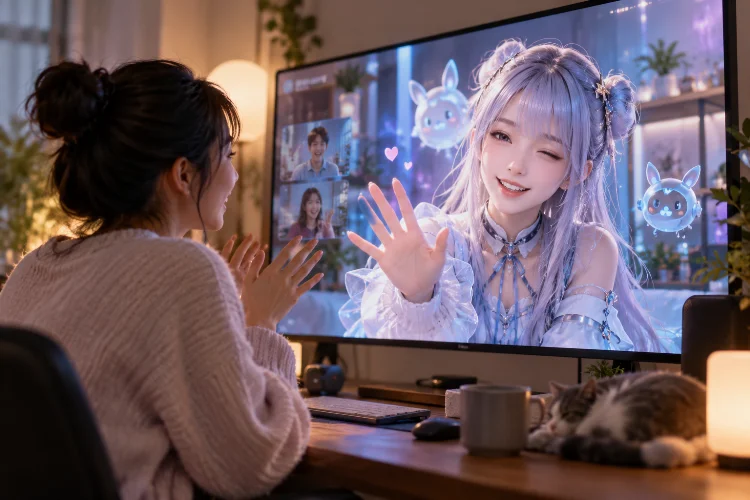
Imagine watching your favorite virtual idol perform live when something unexpected happens.
You type a question in the chat, and the digital character responds almost immediately, remembers a previous conversation, and even adjusts their reaction based on what viewers are discussing.
Pretty impressive, right?
This kind of interactive entertainment is becoming more achievable thanks to machine learning.
Virtual idols have already transformed how audiences experience digital celebrities. Instead of simply watching animated performances, fans can participate in livestreams, influence creative activities, and interact with personalities that exist entirely through digital technology.
Now, machine learning is taking those possibilities further.
By analyzing communication patterns, processing natural language, and supporting personalized experiences, intelligent systems can make virtual performers more responsive to their communities.
However, the technology isn’t only about creating realistic conversations. It’s also changing how creators understand their audiences, manage live interactions, and develop engaging digital entertainment.
Understanding how machine learning enhances virtual idol audience interaction reveals why intelligent technology is becoming increasingly important in virtual entertainment.
Let’s explore what’s happening behind the scenes.
1. Understanding Machine Learning in Virtual Idol Entertainment
What Machine Learning Actually Does
Before exploring its applications, it’s helpful to understand what machine learning means.
Machine learning is a branch of artificial intelligence that allows computer systems to identify patterns from data and use those patterns to make predictions, classifications, or generated outputs.
Traditional software generally follows explicitly written instructions.
Machine learning systems, on the other hand, develop statistical capabilities through training on examples.
For virtual idols, these capabilities can support language processing, speech recognition, audience analytics, recommendation systems, and interactive character behavior.
Imagine a digital performer receiving thousands of messages during a livestream.
Reading every comment manually would be practically impossible.
A machine learning system could help categorize messages, detect frequently discussed topics, and identify questions that might deserve a response.
The technology doesn’t necessarily understand emotions or conversations the same way humans do. Instead, it analyzes patterns that can help software generate more contextually appropriate behavior.
Combining Different AI Technologies
An interactive virtual performer rarely depends on a single algorithm.
Developers usually combine several technologies to create a complete experience.
Natural language processing helps interpret written messages, while language models can generate conversational responses.
Speech synthesis converts text into spoken dialogue, and animation software controls the character’s visible expressions.
Machine learning may assist with several of these functions, although some components still rely on conventional programming or human performers.
A practical example appeared in a 2025 study published in Jurnal Pepadun.
Researchers at Universitas Lampung developed KAIRA, an Indonesian AI-based VTuber that combined GPT-4, ElevenLabs voice synthesis, and VTube Studio animation for conversational YouTube livestreaming.
The project demonstrates how multiple technologies can work together to create an interactive digital personality.
2. Natural Language Processing Makes Virtual Idol Conversations Smarter
Understanding Messages Beyond Simple Keywords
One of the most exciting applications of machine learning involves natural language processing, commonly called NLP.
Older chatbots often relied on predefined keywords.
If someone typed a particular phrase, the system returned a predetermined answer.
That approach works for basic commands, but natural conversations are much more complicated.
Fans use slang, jokes, abbreviations, emojis, and unexpected questions.
Modern language models can interpret a broader range of conversational patterns and generate responses based on the surrounding context.
For example, imagine someone asking a virtual idol:
“Are you going to sing that song again tonight?”
A basic chatbot might struggle without an exact command.
A more advanced conversational system could use information about the livestream schedule and previous performances to create a relevant answer.
That makes the interaction feel more natural.
Responding to Live Chat in Real Time
Livestream environments introduce another challenge: speed.
When hundreds of viewers communicate simultaneously, an AI-powered performer needs to identify relevant messages without interrupting the entertainment experience.
Machine learning can help prioritize messages based on their content, timing, and relevance to the current conversation.
For instance, a virtual singer discussing an upcoming concert might prioritize questions about the event rather than unrelated comments.
However, the system shouldn’t automatically treat paid messages as more important than ordinary fan participation.
A balanced approach encourages wider community involvement.
The complete interaction process might involve receiving a message, checking its safety, identifying its meaning, generating a response, and converting that response into speech.
All these stages contribute to the perceived responsiveness of the character.
Real-World Example: Neuro-sama
One of the best-known examples of conversational AI in virtual entertainment is Neuro-sama, an AI-powered VTuber created by developer Vedal.
Neuro-sama communicates with audiences through generated dialogue, plays games, and participates in interactive livestreams.
A study by Wanyan Wu and Jessa Lingel, published online in New Media & Society in December 2025, explored how audiences experience authenticity during Neuro-sama’s performances.
The researchers identified transparency, emotion, and the potential for technological development as important parts of her perceived authenticity.
Interestingly, audiences can appreciate the character’s technical limitations as part of the entertainment itself.
This suggests that advanced AI interaction doesn’t always need to imitate human behavior perfectly.
Sometimes, the unique personality of an artificial performer becomes part of the attraction.
3. Personalized Fan Experiences Create More Meaningful Engagement
Learning From Audience Preferences
Not every fan enjoys the same content.
Some viewers follow virtual idols for music, while others prefer gaming sessions, casual conversations, or character storytelling.
Machine learning can help creators identify these differences through aggregated audience behavior.
For example, an analytics system might detect that music-related livestreams consistently attract longer viewing sessions than certain gaming broadcasts.
Creators could use those findings to adjust their schedules or experiment with new performance formats.
However, this doesn’t mean every viewer needs an individualized profile.
Privacy-conscious systems can work with anonymous or aggregated data to understand broader community interests.
The objective is to improve entertainment experiences without collecting unnecessary personal information.
How Recommendation Systems Support Discovery
Machine learning also influences how audiences discover entertainment content.
Recommendation systems analyze patterns such as viewing history, content characteristics, and user interactions to identify potentially relevant videos.
A well-known research paper by Paul Covington, Jay Adams, and Emre Sargin, published in 2016, described how YouTube used deep neural networks for candidate generation and video ranking.
Although the research wasn’t specifically about virtual idols, it provides a foundation for understanding algorithmic content discovery.
For digital performers, this can influence how new audiences encounter livestream clips, music videos, and promotional content.
Creators can improve discoverability through clear titles, engaging content, consistent publishing, and accurate descriptions.
Machine learning-driven recommendations may then help connect suitable content with interested viewers.
Still, there is no guarantee that an algorithm will promote a particular virtual idol.
Creating Continuity Through Conversational Memory
Personalization can also involve remembering previous interactions.
Imagine a fan mentioning that they enjoy acoustic music during a community event.
During a later conversation, a virtual idol might refer to that preference if the fan has explicitly agreed to personalized memory.
This creates a sense of continuity.
Research on generative agents, published at UIST 2023, demonstrated how language-model-based agents can use stored experiences, retrieved memories, and reflection mechanisms to produce more coherent simulated behavior.
Similar architectural ideas could support virtual characters with persistent fictional histories.
However, conversational memory is not the same as continuously retraining a machine learning model.
Many systems retrieve stored information during conversations without changing the model’s underlying parameters.
That distinction is important when discussing how AI personalities develop over time.
4. Emotion-Aware Technology Improves Virtual Idol Communication
Detecting Emotional Signals in Text
Communication isn’t only about understanding words.
People also express excitement, frustration, disappointment, and humor through their messages.
Machine learning classifiers can help estimate sentiment or identify emotional language in chat discussions.
For example, a sudden increase in enthusiastic comments might indicate that viewers particularly enjoyed a musical performance.
A virtual idol could then respond with an excited animation or thank the audience.
However, emotion detection is far from perfect.
Sarcasm, cultural differences, internet slang, and mixed emotions can make automated classification unreliable.
A message containing negative words might actually be a joke.
Consequently, developers shouldn’t treat sentiment predictions as definitive evidence of how individual fans feel.
Voice Recognition and Natural Responses
Voice-based interaction introduces additional opportunities.
Automatic speech recognition converts spoken audio into text, allowing conversational systems to process voice input.
Text-to-speech technology performs the reverse operation by generating synthetic speech from written dialogue.
NVIDIA’s Riva documentation describes speech recognition, synthesis, translation, and language-processing technologies designed for conversational AI applications.
These capabilities can support interactive virtual characters that listen and respond through voice.
For example, a digital idol participating in an online fan event could process spoken questions and produce audio responses.
Actual performance depends on network conditions, processing resources, model quality, and system design.
There may still be noticeable delays, especially when several AI components must operate sequentially.
Making Character Reactions More Expressive
Emotional expression can also influence animation.
A character might smile after receiving positive feedback or display a surprised expression when viewers reveal an unexpected event.
Machine learning can assist in choosing expressions based on conversational context.
However, developers should provide clear behavioral rules.
A virtual idol shouldn’t respond to someone’s serious personal difficulties with exaggerated laughter simply because an emotion classifier misunderstood the situation.
Appropriate behavior requires more than automated predictions.
It also depends on thoughtful character design, testing, and human oversight.
5. Machine Learning Helps Creators Understand Audience Engagement
Turning Livestream Data Into Useful Insights
Virtual idol creators often have access to large amounts of audience information.
These may include viewing duration, chat activity, audience retention, content preferences, and participation during special events.
Machine learning can help identify patterns that would be difficult to notice manually.
Imagine a virtual performer hosting three different weekly activities: music sessions, gaming streams, and storytelling events.
An analytics model might reveal that viewers remain engaged for longer during interactive music performances.
That insight could encourage the creator to develop more audience-participation segments.
However, analytics should guide creative decisions rather than control every aspect of production.
Sometimes, experimental content has artistic value even when its immediate engagement numbers are modest.
Predicting Popular Content Formats
Predictive models can estimate which types of content may perform well based on historical information.
For instance, a creator might analyze previous video performance, publication schedules, and audience interaction patterns.
These signals could help estimate interest in an upcoming livestream theme.
The predictions won’t always be accurate.
Audience preferences change, unexpected events influence popularity, and limited data can produce misleading results.
Rather than treating predictions as guaranteed outcomes, creators should use them as one part of a broader decision-making process.
Measuring the Quality of Interaction
High message volume doesn’t necessarily mean a livestream is successful.
A rapidly moving chat might indicate enthusiasm, confusion, spam, or disagreement.
Creators should examine engagement quality as well as quantity.
Useful indicators include whether viewers participate voluntarily, return for future events, and report enjoying the experience.
Testing different interaction formats can also provide useful feedback.
For example, creators could compare a conventional question-and-answer session with a fan-selected storytelling activity.
Over time, these experiments help identify experiences that feel genuinely entertaining rather than simply generating more clicks.
6. Intelligent Interaction Strengthens Virtual Idol Fan Communities
Building a Sense of Social Presence
Fans often return to virtual idols because they enjoy the surrounding community.
Recognizable greetings, recurring jokes, shared celebrations, and livestream traditions can create a sense of belonging.
Interactive technology may reinforce these experiences.
A digital performer could acknowledge community milestones, summarize approved fan suggestions, or introduce collaborative activities.
These interactions make viewers feel more involved in the entertainment.
A 2026 study published in the Journal of Broadcasting & Electronic Media examined 316 VTuber viewers in mainland China.
The researchers found that perceived authenticity and interactivity were positively associated with parasocial relationships and social presence.
The findings don’t prove that adding machine learning automatically improves fan relationships.
However, they suggest that interactivity and authenticity deserve attention when designing virtual entertainment experiences.
Encouraging Community Participation
Machine learning can support interactive events where audience participation shapes the performance.
Imagine fans voting on which fictional location a virtual idol should explore during a storytelling livestream.
A system could collect responses, organize suggestions, and help the performer introduce the winning option.
Similarly, language-processing tools could summarize commonly requested songs or recurring community questions.
This helps creators respond to large audiences more efficiently.
The important part is preserving meaningful participation.
Fans should understand how their contributions affect the experience.
Supporting Multilingual Fan Communities
Virtual idol audiences frequently include viewers from different countries.
Language barriers can make participation difficult, especially during fast-moving livestreams.
Machine translation can help convert messages between supported languages.
For example, a Japanese-speaking virtual idol might receive an English question, process a translation, and respond using an appropriate language model or voice system.
This could make international interaction more accesible.
Nevertheless, translations may misinterpret humor, cultural references, or informal expressions.
Human review remains valuable for important announcements and sensitive conversations.
7. Challenges and Ethical Considerations in AI-Powered Fan Interaction
Protecting Fan Privacy
Personalization can improve digital experiences, but collecting too much audience information creates risks.
Chat histories may contain usernames, personal stories, or sensitive details.
Developers should avoid storing information unnecessarily.
A responsible system should explain what data is collected, how it is used, and whether fans can remove information associated with their accounts.
Whenever possible, analytics should rely on aggregated information.
Conversational memory should also use clear permission settings.
Trust becomes especially important when audiences believe they’re interacting with a familiar digital personality.
Avoiding Manipulative Emotional Connections
Virtual idols can inspire meaningful emotional attachments.
However, creators should avoid using machine learning to exploit those feelings.
For example, a system shouldn’t analyze someone’s emotional vulnerability to encourage expensive purchases or excessive donations.
Likewise, a digital performer shouldn’t imply that paying more guarantees affection or exclusive friendship.
Healthy fan relationships depend on respect and realistic expectations.
Clear disclosure about automated responses helps audiences understand the nature of the interaction.
Creators should also ensure that fans can enjoy free content without feeling pressured to spend money.
Managing Errors and Inappropriate Responses
Machine learning models occasionally produce incorrect, offensive, or irrelevant outputs.
During livestreams, these mistakes can become particularly visible.
A language model might misunderstand a question, repeat unreliable information, or respond inconsistently with the character’s personality.
Developers can reduce these risks through content filters, restricted knowledge sources, moderation tools, and human intervention.
Testing should include unusual questions, multilingual comments, sarcasm, and attempts to manipulate the system.
The U.S. National Institute of Standards and Technology provides an AI Risk Management Framework that emphasizes incorporating trustworthiness into AI design, development, and evaluation.
Although the framework isn’t specific to virtual idols, its principles are relevant to interactive entertainment systems.
Balancing Automation With Human Creativity
It’s tempting to imagine virtual idols eventually handling every interaction automatically.
However, automation doesn’t automatically create better entertainment.
Character development, storytelling, musical identity, and community culture still require meaningful creative direction.
Even a highly advanced conversational model can produce repetitive or inconsistant behavior without appropriate guidance.
Creators need to decide which interactions should be automated and which deserve direct human involvement.
A hybrid approach may offer the strongest results.
Machine learning can handle selected technical tasks while writers, performers, developers, and community managers preserve the character’s artistic identity.
Future systems will likely become increasingly sophisticated, but their success will still depend on the experiences they create for real people.
Machine learning is changing how virtual idols communicate with audiences, making digital entertainment more interactive, adaptable, and personalized.
From natural language processing and speech synthesis to audience analytics and community engagement, intelligent technologies offer creators new ways to develop responsive virtual personalities.
However, successful interaction involves more than advanced algorithms.
Trust, emotional authenticity, creative storytelling, privacy protection, and community participation remain essential.
The most engaging virtual idols won’t necessarily be those with the most complicated AI systems. They’ll be the ones that combine useful technology with distinctive personalities and meaningful fan experiences.
Ready to explore machine learning for your own virtual idol project? Start with one practical interaction feature, test it with your audience, and build an experience that puts fans and creativity first.
